It Takes Two (Concurrence)

Updated: 6 days ago
Sermon Recap: QUESTION AUTHORITY, says the old bumper sticker. These days a healthy suspicion of power can feel like a spiritual discipline, and this week, every reading featured someone doing exactly that. At Rephidim, a thirsty Israel turns on Moses. But their real question lies underneath: "Is the LORD among us or not?" (Exodus 17:7). God answers by standing on the very rock Moses strikes, and water flows from the place where the blow lands.
God's authority isn't a bigger version of the human kind. "Authority" shares a root with "author," from the Latin for "to make grow." Human authority works as a trade: someone gains a say and someone else gives one up. God doesn't compete for our choices, because God gave us the capacity to choose in the first place. That's why Paul can say "work out your own salvation" and "it is God who is at work in you" in the same breath (Philippians 2:12-13). God's authority and our freedom grow together.
So keep questioning the voices that want to write your story. The answer to bad authority isn't no authority. It's the one Author whose authority over you is the source of your freedom, and whose track record we're called to remember.
(Given 9-27-26, St. Augustine's Church, Kingston RI)

Concurrence
Imagine that you finally call a friend you have been avoiding for months. Who made that call, you or God? Most people would instinctively answer "a little of both," but the classical Christian tradition says the call was made entirely by you and entirely by God. Thomas Aquinas argues that when something happens through a creature, it is not done partly by God and partly by the creature, but wholly by both, in different ways (Summa Contra Gentiles III.70). Theologians call this concurrence, from the Latin for "running together."
This only sounds like faulty arithmetic if God and human beings are the same kind of cause. Aquinas argues that they are not. Human beings are secondary causes, acting within the world. God is the primary cause, who gives existence to the world, to each creature, and to every act a creature performs. Because God does not act on our level, God's involvement does not reduce our own.
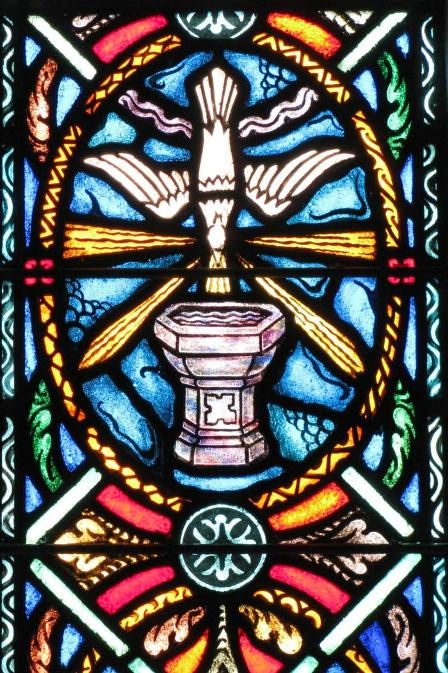
A stained-glass window illustrates the point. On a sunny morning, the blue light on a church floor comes entirely from the glass and entirely from the sun. Stronger sunlight does not make the window less itself; it makes it more vivid, and blocking out the sun would not give the window independence, only darkness. Likewise, the phone call belongs fully to you, while God fully sustains your existence, your ability to choose, and the good you are choosing.
Concurrence stands between two opposite errors. Deism holds that God created the world and then withdrew, leaving creatures to act on their own. Occasionalism, defended by the medieval Muslim theologian al-Ghazali and later the French philosopher Nicolas Malebranche, holds that God is the only true cause: fire does not burn cotton; God burns the cotton whenever fire is present. Aquinas thought this underestimated God's generosity. God governs through creatures, he argued, not from lack of power but to share with them "the dignity of causality" (Summa Theologiae I.22.3).
If God is fully involved in every human act, is God also responsible for sin? Aquinas answers with the image of someone walking on an injured leg: the movement comes from the person's strength, but the limp comes from the leg (Summa Theologiae I-II.79.2). God gives every act its being and energy; the distortion comes from the creature. Evil is not something God creates but a flaw within something good.
The contemporary theologian Kathryn Tanner has shown why this classical view still matters. In God and Creation in Christian Theology (1988), she argues that Christian speech about God depends on two rules held together: God is truly transcendent, not merely the highest thing in the universe, and God is directly involved in everything that exists. We tend to assume these rules pull against each other, so that a more transcendent God must be more distant, and a closer God must crowd us.
Tanner traces that assumption to what she calls "contrastive" transcendence, which defines God as the world's opposite: infinite where we are finite, active where we are passive. Defined this way, God quietly becomes one more thing on our level, only larger, and two things on the same level can share a space only by dividing it. Her alternative is "non-contrastive" transcendence. Because God is not a being alongside other beings, God has no need to compete with creatures for room; God's transcendence is exactly what makes God's closeness possible.
Her subtitle names the stakes: Tyranny or Empowerment? Picture God as a competitor, and divine power starts to look like domination and human freedom like rebellion. Much of modern theology, Tanner suggests, has swung between shrinking human agency to protect God's sovereignty and shrinking God to protect human freedom. The non-competitive view refuses that choice: the more fully God gives, the more fully we are able to act.
Sources
Thomas Aquinas, Summa Contra Gentiles, Book III, Ch. 70 (the same effect is wholly from God and wholly from the created agent).
Thomas Aquinas, Summa Theologiae I, q.22, a.3 (God governs through creatures to share "the dignity of causality"); I, q.105, a.5 (against the view that creatures do not truly act); I-II, q.79, a.2 (the limping analogy for God's relation to sinful acts).
Al-Ghazali, The Incoherence of the Philosophers (c. 1095), Seventeenth Discussion (fire and cotton).
Nicolas Malebranche, The Search After Truth (1674–75).
Kathryn Tanner, God and Creation in Christian Theology: Tyranny or Empowerment? (Blackwell, 1988).

Comments