Water Under the Bridge? (Baptism)
Sermon Recap: This Sunday landed five days shy of the twenty-fifth anniversary of September 11th, and the sermon didn't dodge it. We've spent twenty-five years insisting we'll "never forget" — a phrase carved onto memorials and stamped on fire trucks, more commandment than invitation. Which made it a strange week, and exactly the right week, for Peter to walk up to Jesus asking about forgiveness.
Peter offers seven as his generous ceiling — more than double what most rabbis of his day would have said, in case anyone's counting (Peter was). Jesus answers "seventy-seven" (Matthew 18:22), which isn't a bigger number to count toward so much as an instruction to stop counting altogether. He backs it up with a parable: a servant forgiven an impossible debt — ten thousand talents, more than a whole province could raise in taxes — turns around and has a fellow servant thrown in prison over about a hundred dollars. When the king finds out, the servant isn't handed over for owing money. He's handed over for receiving mercy and refusing to pass it on (Matthew 18:23-35).
Leaning on Dr. Gerry Breshears, the sermon named what forgiveness is not — forgetting, a feeling, reconciliation with someone unsafe, a one-and-done event — before landing on what it is: handing justice back to God, choosing someone's good anyway, an unmerited gift by design. Unforgiveness, the sermon argued, doesn't punish the person who hurt you. It builds you a cell, and you move in.
Then there was a font. Before a drop of water touched the two children baptized that morning, the whole church said out loud that whatever either of them will ever do has already been met with a mercy they did nothing to earn. That's baptism, the sermon closed — God preemptively canceling a debt, the same way the king in the story did. Which means whatever debt you're still keeping on someone, you already have what you need to cancel it too.
(Given 9-13-26, St. Augustine's Church, Kingston RI)
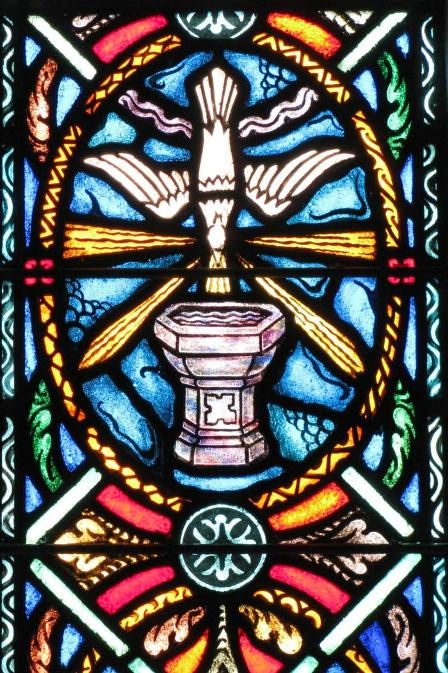
Baptism
So, that font. The two kids baptized that morning weren't just a nice sermon illustration — they're actual children who had actual water poured on their actual heads this Sunday, which means it's worth asking what the Church thinks it's doing when it does that. Two thousand years of arguing later, nobody's fully settled it, and honestly, that's fine — some questions are worth sitting with rather than closing.
Start with the obvious one: why do this to babies who can't consent to anything, let alone recite a creed? Tertullian, writing around 200 CE, thought that was the whole problem — baptism only works once, so why burn your one shot before you're old enough to actually want it (Tertullian, On Baptism, c. 200 CE)? Plenty of devout parents agreed with him for generations, including — a little ironically, given what's coming — the mother of a baby named Augustine, who made him wait. Cyprian of Carthage thought the hesitation missed the point entirely: a council of sixty-six bishops he convened in 253 ruled infants could be baptized before they were even eight days old, because grace was never something you had to grow into deserving (Cyprian, Epistle 58, to Fidus).
That baby Augustine grew up, got baptized as an adult himself, and then wrote the argument that tipped the West firmly onto Cyprian's side anyway: original sin. Reading Romans 5:12, he argued every kid inherits Adam's guilt right along with Adam's mortality — so the font isn't a nice gesture performed on an infant, it's doing something (Augustine, On the Merits and Forgiveness of Sins, and the Baptism of Infants, 412 CE).
If original sin doesn't do it for you, you're in good Episcopal company — most of us don't lean on it, and the Prayer Book's own catechism skips it entirely: "Infants are baptized so that they can share citizenship in the Covenant, membership in Christ, and redemption by God" (BCP Catechism, p. 858). Two better images get you to the same font: prevenient grace, God's love showing up before anyone can respond to it, and covenant inclusion — the same logic behind circumcising Israelite infants into the covenant before they could agree to anything, which Paul calls baptism "a circumcision made without hands" (Colossians 2:11-12).
Whichever theology gets you there, the Prayer Book is clear nobody at that font is going it alone. "Holy Baptism," it opens, "is full initiation by water and the Holy Spirit into Christ's Body the Church" (BCP, p. 298). Which is why, before the vows are even said, the whole congregation gets asked a question of its own: "Will you who witness these vows do all in your power to support these persons in their life in Christ?" And everyone answers together — "We will" (BCP, p. 303).
So when the parents made their promises this week, the rest of us signed on right alongside them — and that's not just cozy communal spirit, it's the doctrine's actual claim. Your ability to cancel someone else's debt was never a moral achievement you had to work up to. It's downstream of a debt that was already canceled at your own font, whether or not you were paying attention at the time. Forgiveness that starts with your willpower, your readiness, or their apology runs out, because all three are yours to withhold. Forgiveness that starts at the font doesn't, because none of it was ever yours to begin with.
Sources
Tertullian, On Baptism (c. 200 CE).
Cyprian of Carthage, Epistle 58, to Fidus (Council of Carthage, 253 CE).
Augustine of Hippo, On the Merits and Forgiveness of Sins, and the Baptism of Infants (412 CE).
Philip Schaff, History of the Christian Church, Vol. III.
Andrew Koperski, "Baptismal Trajectories in Early Christianity," Ad Fontes Journal.


Comments